
"Prove it" is not a measurement problem. It is a plumbing problem.
IAB Australia says programmatic outdoor has hit its "prove it" moment. The data to prove ROI already exists. It just lives in two systems that never meet.
In August, Mediaweek's Tom Gosby reported on IAB Australia's Programmatic Digital Out-of-Home State of the Nation 2026 under a headline that should be pinned above every media owner's desk: programmatic outdoor faces its "prove it" moment.
"The conversation has moved from 'explain it to me' to 'prove it to me'."
That line comes from Gai Le Roy, CEO of IAB Australia. It is the most useful sentence written about this channel all year, and it deserves a direct answer.
The demand is there. The evidence is not.
The report surveyed 163 advertising decision-makers in July 2026. The appetite is not in question: 75% of agencies expect their pDOOH spend to grow over the next year, and 82% already factor it into cross-channel planning.
What holds budgets back is evidence. 42% named demonstrating ROI as the single biggest barrier. Audience measurement came next at 23%. Understanding cost versus benefit, channel capabilities, role in the media mix and ad effectiveness measurement each sat at 22%.
Meanwhile, 76% of agencies still measure effectiveness through impressions delivered. That is the gap in one number. The channel is being judged on a figure that describes how often a screen was on, not how many people it reached.
The data exists. It lives in two places that never meet.
It is tempting to read the report as a measurement problem: the industry needs better data. We think it is a plumbing problem. The data needed to prove a campaign worked already exists in most networks. It is just filed in two separate systems.
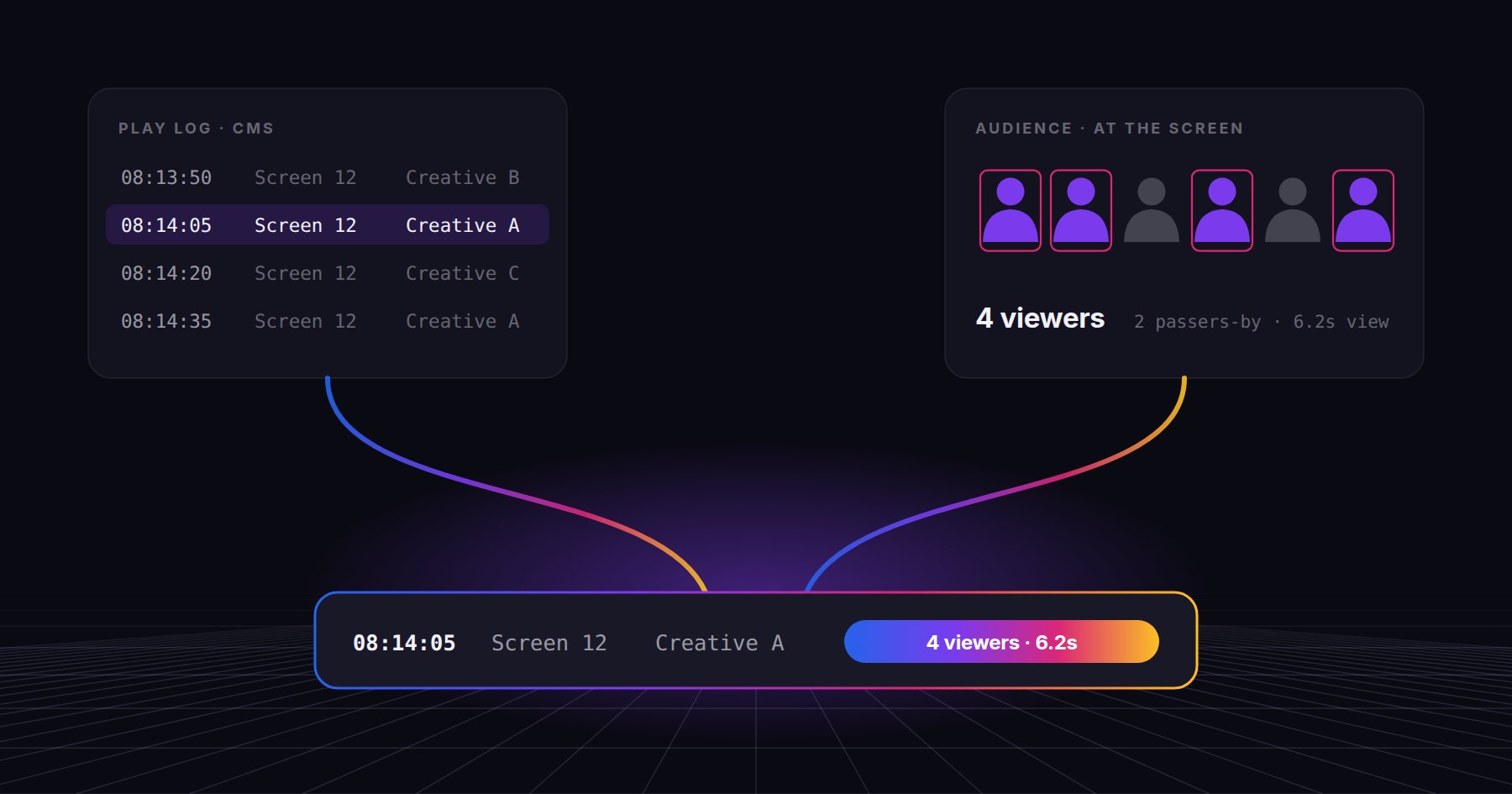
- Proof-of-play lives in the CMS. It records that creative A ran on screen 12 at 8:14:05am. It says nothing about who was there.
- Audience is usually modelled, and often after the campaign has finished. It describes who was likely nearby, on average. It says nothing about a specific play.
Neither is proof on its own. Put them in the same row, and the conversation changes: this creative, on this screen, at this second, seen by this many real people, for this long. That is no longer a debate about methodology. It is a media plan.
Measure the look, not the crowd
Joining the data is half of it. The other half is being honest about what counts as an audience. Plenty of people walk past a screen without looking at it. A number that counts them all flatters the site and erodes trust the first time a client checks it.
This is why we separate viewers from passers-by, and report look rate, dwell time and view time alongside each other. It often makes the headline reach number smaller. It also makes it a number an agency can defend to its client.
The 43% nobody is talking about
The report's quieter finding may matter more. 43% of respondents are unsure how Australia's privacy reforms will affect DOOH. A measurement story that cannot survive a privacy conversation is a liability, however good the numbers look.
The answer is to design privacy in, not bolt it on. Measure the audience, never the individual: detect heads rather than faces, process everything on the device at the screen, keep only anonymous counts, and store no images at all. We wrote more about this in head detection vs facial recognition.
What media owners can do this quarter
- Pick your ten most valuable screens and measure the real audience there first. Prove it where the rate card matters most.
- Join plays to audience per play, not per month. A monthly average cannot win a renewal conversation.
- Report look rate, not just footfall. A smaller, defensible number beats a bigger one nobody believes.
- Keep trading on MOVE. The industry currency is how outdoor is bought and sold. Observed per-play data is how you prove what happened. See MOVE 2.0 explained.
- Lead with privacy. Have your answer ready before a client's legal team asks the question.
Answering the question
"Prove it to me" is a fair ask, and outdoor can meet it. The industry does not need to invent a new kind of data. It needs to connect the two it already has, and be honest about the difference between a screen that played and a person who looked.
That is what we built UrbanIQ to do. If you want to see it on a live screen, with the audience number moving as people walk past, start here or book a demo below.
Source: IAB Australia, Programmatic Digital Out-of-Home State of the Nation 2026, as reported by Mediaweek, 17 August 2026.